Approaches to supporting and managing mental health, if not landed correctly, can leave a bad taste in the mouth, but this should not be an excuse for not having the conversation at all. January for many is a tough month, and since 2005 has been the month on which the infamous ‘blue monday’ has fallen, often labelled the most depressing day of the year.
Is Blue Monday real, and if so, what are the safety implications? If any? Here we take a look.
What is Blue Monday?
Blue Monday is the name given to a day in January that’s often described as “the most depressing day of the year”. The term was popularised in 2005 by Cliff Arnall, a former Cardiff University health psychologist and postgraduate medical and dental tutor, after a press release linked to a UK travel company, Sky Travel. In that telling, the “Blue Monday” idea is positioned as the point in January when a mix of pressures combine ranging from low levels of light to a lack of follow-through on New Year’s resolutions.
Over time, Blue Monday has taken on a life of its own. Many people now treat it as a cultural reference point rather than a scientific claim. Some mental health organisations have used Blue Monday as a prompt to encourage more open conversation about wellbeing and mental health, focusing on support and early help-seeking rather than the label itself.
When is Blue Monday?
Blue Monday is typically said to fall on the third Monday in January so typically in the middle to later part of the month, but this isn’t fixed. You’ll sometimes see it reported as the second or even the fourth Monday, depending on how media outlets or campaigns choose to frame it.
Historically, the first declared Blue Monday date was 24 January 2005, shared as part of a Sky Travel press release. The date is also described as only applying to the Northern Hemisphere, because the “calculation” commonly references winter conditions such as weather and reduced light.
Is Blue Monday Real?
This is where it gets tricky: Blue Monday is widely dismissed as pseudoscience, mainly because the famous “formula” behind it doesn’t stand up to scrutiny. The equation is said to combine factors such as:
- weather / light exposure
- debt level versus ability to pay
- time since Christmas
- time since New Year’s resolutions were broken
- low motivation
- the feeling of a need to take action
The problem is that key parts of the formula are not clearly defined, no units are provided, and it can’t be tested in a meaningful way. In other words, it doesn’t function as a reliable, scientific calculation of “the most depressing day”. Critics have also pointed out that similar equations associated with the concept fail basic checks for mathematical sense, because the inputs and outputs don’t consistently relate to each other in a way you could verify.
Despite the widespread criticism, some papers have shown a worrying correlation between Mondays and suicides, as summarised by Kim et. al below:
“Many studies have reported that suicides tend to occur on Mondays. However, owing to a lack of controls, conclusive findings on the potential effects of a day of the week on suicides have been lacking. We analyzed public data for causes of death from 1997 to 2015 in the Republic of Korea. Accidental death was used as a control group. The probability of suicide on each day of the week according to age group was calculated. A total of 377,204 deaths (188,601 suicides and 188,603 accidental deaths) were used. The frequency of suicide was highest on Monday and decreased throughout the week until Saturday. Accidental death was highest on Saturday and showed no variations according to weekday. For people in their teens and 20s, the probabilities of suicide on Monday were 9% and 10% higher, respectively, than those on Sunday. As age increased, the differences in suicide probability according to the day of the week were attenuated. The so-called Blue Monday effect is real, particularly for people in their teens and 20s. Suicide prevention strategies that aim to attenuate the burden and stress of Mondays should be planned.”
So for many, the first day of the week can be a tricky time, but it does not offer specific validation for the January date for Blue Monday.
That said, while Blue Monday as a single “worst day” isn’t evidence-based, the themes it draws on can still reflect real experiences for many people in January: reduced daylight, disrupted routines, financial strain after the holidays, and a general return-to-work pressure. In a workplace context, it can be more useful to treat Blue Monday as a communications hook, potentially around safety practices and mental health support.
Do more traffic accidents happen in January and on Mondays?
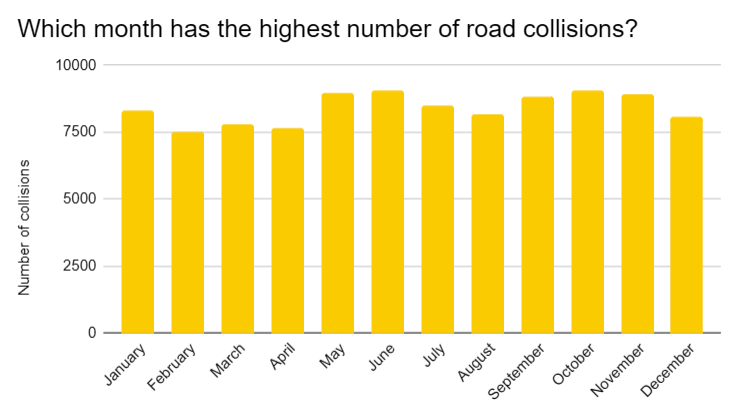
There is little publically available data regarding total accidents at work so we have taken a look at the comparable metric of road traffic collisions throughout the year from UK Government data to find which months of the year have the highest number of accidents; whilst there was no month with a vastly higher number of incidents, January was by far the month with the highest number of accidents vs the other winter and autumn months which is something for fleet managers with safety responsibilities to be mindful of.
Blue Monday falls in January, so awareness measures around safe driving tied into this time of the month could be useful.
What is the most dangerous day to drive?
In the data analysed, Friday recorded the highest number of road traffic collisions, while Monday had the lowest collision count among weekdays (with Saturday and Sunday excluded). This pattern suggests risk builds as the working week progresses, with Friday bringing a mix of heavier travel demand (commuting plus leisure trips), tighter schedules, and end-of-week fatigue. By contrast, Monday travel may be more routine and predictable, with fewer discretionary journeys and a steadier flow of traffic across the day.

What to consider with Blue Monday and Safety
Blue Monday as a specific “most depressing day” has little scientific evidence, but the cluster of pressures it points to (winter fatigue, stress, motivation dips, post-holiday workload and money worries) can still show up in ways that matter for safety. For health and safety teams, the value is using mid-January as a seasonal risk prompt for human factors: attention, decision-making, behaviour and reporting culture.
Here are four angles that translate well into a health and safety context:
- Distraction and reduced concentration
When people are mentally overloaded, they’re more likely to miss steps, misread instructions, or rush checks. That matters most in safety-critical tasks: driving for work, operating machinery, medication rounds, lone working, working at height, and any task where a small error can escalate.
- Fatigue and sleep disruption (dark mornings, winter routines)
Fatigue isn’t just “feeling tired” — it affects reaction time, information processing, coordination, attention and risk perception. HSE notes fatigue can lead to errors and accidents and is linked to slower reactions and reduced attention, among other impacts. - Stress load and behaviour changes
Stress can surface as irritability, conflict, poorer decisions, or people “pushing through” when they’re not fit to work safely. It can also reduce the likelihood of raising concerns or reporting near-misses (because people feel they don’t have time, don’t want attention, or assume it’s “just them”). HSE also advises managers to look out for behaviour changes that may indicate stress linked to work pressure.
- Return-to-work pressure after the holidays
January can bring backlog clearing, new targets, short staffing, and a “hit the ground running” mindset. This maps directly onto known workplace stressors such as
- Financial stress (common in January narratives)
While employers can’t fix personal finances, they can reduce avoidable work stressors and make support routes clear (EAP, occupational health, HR, manager check-ins). Financial strain can add to mental load, which in turn can increase distraction and fatigue at work.
How to talk about Blue Monday without making it worse
If you choose to reference Blue Monday in internal comms, the goal is to use it as a gentle prompt to check in on wellbeing and diligence, not amplify it as the ‘worst day’ of the year:
Do
- Acknowledge January can be tough
Keep it simple and inclusive: winter routines, dark mornings, post-holiday workload and life admin can all add strain — and it’s normal to feel the impact. - Focus on practical support and workload design
Point to what people can actually do today: prioritise, take breaks, raise capacity issues early, and use agreed processes for managing high-risk tasks (double-checks, pause points, buddying for lone working where possible). - Reinforce that asking for help is normal
Make it clear that speaking up is a strength — whether it’s about workload, fatigue, stress, or something outside work affecting concentration.
Don’t
- Declare “the most depressing day” as fact
Blue Monday is widely criticised as pseudoscience, so stating it as truth can damage trust and alienate staff who don’t relate to it. - Assume everyone feels low
Some people feel fine in January; others may feel worse. Avoid blanket statements like “we’re all struggling today” — they can be unhelpful or even triggering. - Use it as a one-day wellbeing tick-box
A single post and a helpline link isn’t a strategy. If you mention Blue Monday, connect it to ongoing actions: manager check-ins, workload controls, and sustained support.
To summarise, whether or not Blue Monday is real or grounded in any kind of data doesn’t matter so much in as much as it is a day that people will continue to talk about and acts as a good anchor within the first month of the year to be mindful of well-being and safety initiatives in your workplace, it is in everyone’s best interest to work as safely as possible, getting that message across to staff and getting them engaged with it can only be a good thing for the rest of 2026.