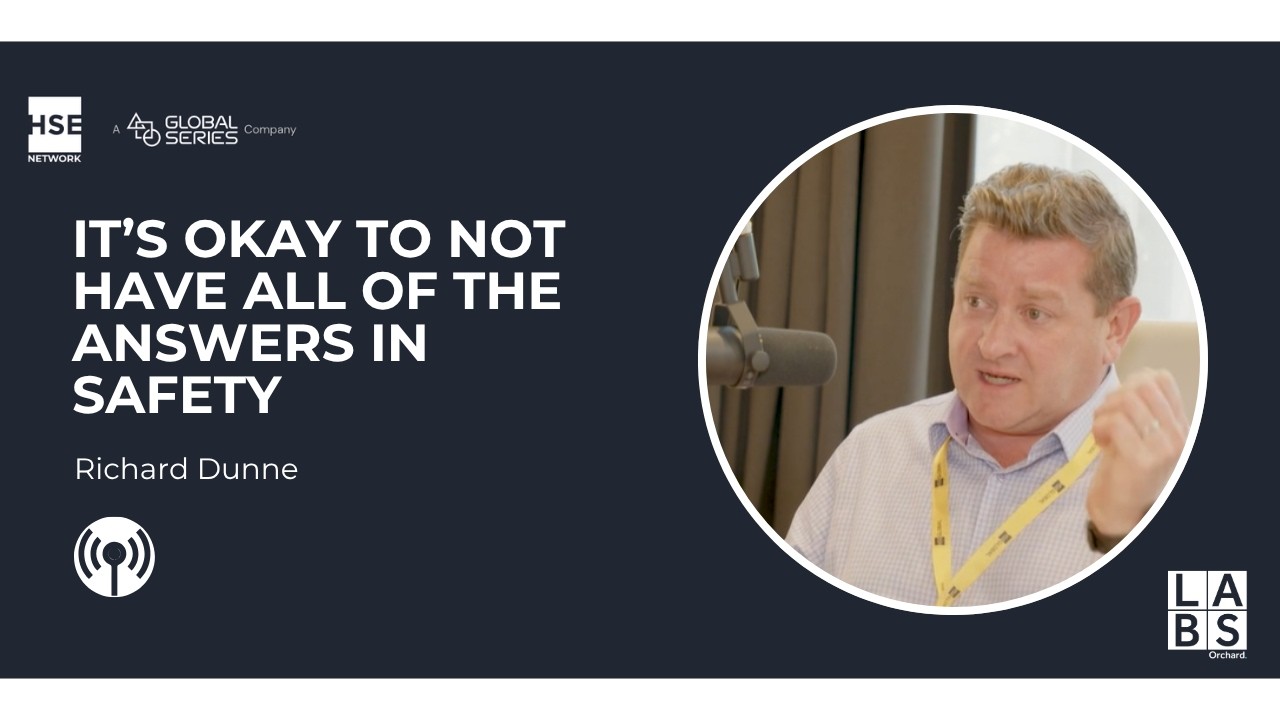
This article has been put together from an interview between Richard Dunne and Dai Butcher from the HSE North American Congress.
For Richard Dunne, senior EHS leader in the consumer packaged goods sector, health and safety has never simply been about compliance. It is about people, business performance and creating an environment in which employees can do their jobs safely and effectively.
Speaking with Dai at an HSE Global event in Nashville, Richard reflected on his journey into environmental, health and safety (EHS), why organisations need to get the fundamentals right before chasing the latest safety trends, and how the industry can improve training, collaboration and knowledge sharing.
How did you get started in your career?
Richard: I actually started in operations. My initial training after university was in engineering and manufacturing, and after several years I began taking on specific EHS and quality projects.
Initially, I saw those projects as an opportunity to become a more rounded operations leader. But once I got involved, I found a real connection with the purpose behind EHS. It was about more than getting products out of the door; it was about people.
That connected with me emotionally. Opportunities followed, and I gradually moved further into EHS leadership. That journey also took me from Ireland to the United States in 2008, where I have continued my career.
Health and safety can sometimes be viewed as a technical profession, but there appears to be a strong element of empathy behind it. Do you agree?
Richard: Absolutely. People come into EHS from different directions. Some are fascinated by the technical science or the psychology behind strong safety performance, but ultimately there is a connection to people.
We are here to save lives, protect people and make sure employees go home in the same condition they arrived in. That makes it an incredibly fulfilling profession.
There is a lot of discussion about getting health and safety represented at the executive table. How can EHS leaders strengthen that relationship?
Richard: I have rarely met an executive who does not support the principle that employees should be protected. The challenge is not necessarily persuading executives that safety matters.
Executives are also there to run and grow the business. EHS needs to demonstrate how it contributes to that objective.
Protecting people is clearly critical, but we must also show how good EHS performance supports the wider organisation. The more effectively we connect safety with the issues business leaders are thinking about every day, the more clearly we can demonstrate our value.
You have spoken about the importance of building safety culture on strong foundations. What does that mean in practice?
Richard: Safety culture is incredibly important, but organisations cannot forget the basics.
Imagine asking an employee how they feel about safety while they are required to put their hand into a moving machine several times a day. At that point, you are asking the wrong question. Before talking about culture, mindset or engagement, you need to fix the fundamental hazard.
I sometimes describe it as telling somebody, “Go in there and be safe”, while sending them into a room full of bear traps. You have to remove the bear traps first.
Once the baseline compliance requirements and physical safeguards are genuinely in place, you have a solid foundation on which to develop a more mature safety culture.
Does the industry also need to rethink the way it trains people?
Richard: Definitely. Imagine calling a plumber and discovering their only qualification was reading a 50-page PowerPoint presentation. You probably would not have much confidence in them.
Trades use apprenticeships because people learn through a combination of education, observation and practice. Someone watches an experienced professional, practises the task themselves and demonstrates that they can perform it correctly.
EHS needs to embrace more of that thinking.
As an industry, we can fall victim to “death by PowerPoint”. We give someone a long presentation, tick the training box and assume they understand everything. Then, when something goes wrong, we wonder why they cannot remember something buried on page 47.
We need to simplify information, identify what people genuinely need to know and give them opportunities to practise it. Training should prove understanding and retention, rather than simply prove attendance.
What role do events and professional communities play in improving safety?
Richard: They can play a huge role, particularly when they move beyond a sequence of presentations.
A room full of experienced EHS professionals potentially contains the answers to many of the problems people are facing. The real value comes when attendees feel comfortable bringing those problems into the room and discussing them openly.
The most effective conferences are the ones where you leave with something you can actually take back and implement in your business.
It also requires some vulnerability. Experienced professionals can sometimes feel they should already have every answer. We need environments where somebody can say, “I’m struggling with this and I need some help.”
The more regularly these communities come together, the greater that trust becomes and the more useful those conversations can be.
Three key takeaways
1. Strong safety culture starts with the basics.
Engagement, psychology and cultural programmes cannot compensate for unresolved physical hazards or weak compliance. Organisations need solid foundations before moving towards more advanced safety initiatives.
2. Training must focus on capability, not completion.
Completing a presentation or signing a training record does not demonstrate competence. Effective EHS learning should be simple, practical and reinforced through observation, practice and demonstration.
3. EHS must connect people protection with business performance.
Safety leaders can strengthen their influence by showing how effective EHS supports the wider goals of the organisation. At the same time, collaboration across the profession gives leaders access to practical ideas and solutions they may not discover alone.
Richard’s message is ultimately one of progression: establish the fundamentals, build real capability and then create the culture and collaboration needed to take safety performance further.
About the author

David Foy: Head of Content at HSE Network
David leads the content delivery team at HSE Network and handles the day-to-day management of advertorial and editorial content campaigns. David has experience in safety content creation across written and podcast-based mediums and has been working with HSE Network for over 5 years.