Health and safety teams are used to managing physical hazards: trip hazards, faulty equipment, poor lighting. Financial stress rarely appears on that list, yet it belongs there. Under the Management of Health and Safety at Work Regulations 1999, employers have a duty to assess risks to health, and that includes psychological health. Stress caused by money worries is a workplace risk in the same way that a loose handrail is, even though it cannot be seen on a walk-round inspection.
Why this sits within health and safety, not just HR
Financial wellbeing is often treated as a secondary HR topic, separate from the day-to-day work of safety management. That separation does not hold up well in practice. Stress affects concentration, reaction times, and decision-making, all of which have direct safety implications on top of the wider effect on mental health. A distracted worker on a shop floor, in a warehouse, or driving between sites is a safety risk regardless of what is causing the distraction.
The Health and Safety Executive’s own Management Standards for work-related stress already recognise this link between personal pressure and workplace risk. Financial strain rarely stays contained to home life. It follows people into work, and it can lower the margin for error in tasks that depend on sustained attention.
The scale of the problem
Recent research from Great Western Credit Union, carried out in partnership with Varn, looked at Google search trends for terms related to financial and emotional strain across the UK, specifically “stress” and “debt”. Both terms are now at their highest search volume in five years. That is a useful proxy for how visible financial pressure has become in people’s daily lives, and it points to a problem that safety and wellbeing teams cannot treat as marginal.
For employers, this is a signal worth acting on rather than a passing statistic. Rising search interest in stress and debt suggests more employees are quietly carrying financial pressure into work, often without flagging it through formal channels such as an occupational health referral or a return-to-work conversation.
What the GWCU research shows
The Great Western Credit Union and Varn research is worth setting out in a bit more detail, since it gives safety teams something concrete to point to rather than a general sense that financial stress exists. The study analysed UK Google search volumes for terms directly tied to financial and emotional strain, rather than relying on self-reported survey data, which is often affected by people underplaying financial difficulty.
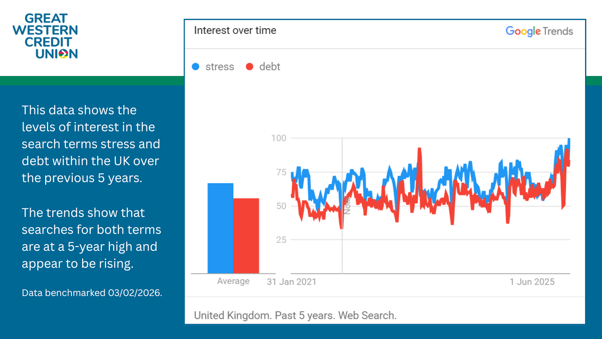
Search interest in both “stress” and “debt” has reached its highest point in five years. Because search behaviour tends to reflect what people are dealing with in the moment, rather than what they are prepared to disclose to an employer or in a survey, this gives a more honest read of how widespread financial pressure has become than absence figures or engagement surveys typically allow for.
For safety teams, the practical value of this research is that it moves financial stress out of the category of anecdotal concern and into something that can be evidenced. A five-year high in relevant search terms is the kind of external data point that can support a case for including financial pressure in a stress risk assessment, in the same way that sector accident statistics or HSE guidance are used to justify other control measures.
Where the risk compounds
There is a particular pattern worth flagging to safety teams. The things that normally help people recover from work-related stress, such as a holiday, a family day out, or simply time off without money worries attached, increasingly come with their own financial cost. Some employees are covering that cost through credit rather than savings. The result is that a period intended to support recovery can end up creating a fresh source of pressure once the employee is back at work.
From a risk management perspective, this matters because recovery time is part of how organisations manage stress-related risk. If annual leave stops functioning as genuine recovery time, the underlying risk does not reduce between periods of high workload, it simply carries over.
What employers can do
Addressing this does not require a new HR policy detached from existing safety processes. It fits naturally alongside the psychosocial risk assessments many organisations already carry out. Practical steps include:
- Including financial stress explicitly within existing stress risk assessments, rather than treating it as an unrelated personal matter
- Making sure line managers are equipped to recognise signs of financial pressure during one-to-ones, in the same way they are trained to spot other stress indicators
- Signposting ethical, not-for-profit providers such as Great Western Credit Union, which are structured to support members rather than generate profit from financial difficulty
- Introducing payroll-linked savings schemes, which give employees a straightforward way to build a buffer before money is absorbed into everyday spending
- Reviewing internal communications so that financial wellbeing is discussed as part of normal health and safety conversations, not only raised after a problem has already developed
Building it into existing safety frameworks
None of this needs to sit apart from established practice. Most organisations already run some form of stress risk assessment under HSE guidance. Financial pressure can be added as a recognised contributing factor within that same process, assessed and reviewed in the same way as workload, relationships at work, or role clarity.
Employers who signpost support early, before financial pressure escalates into a formal absence, are managing a psychosocial risk in exactly the same way they would manage a physical one: by identifying the hazard, assessing the exposure, and putting reasonable controls in place.
The safety case for a broader view
Financial wellbeing will always include a safety net for emergencies, and that has not changed. But treating money worries purely as a private issue, unconnected to workplace risk, leaves a gap in most organisations’ approach to psychosocial hazards. Bringing financial stress into the same conversation as other recognised stress factors, supported by practical measures and credible external partners such as Great Western Credit Union, gives employers a more complete picture of the risks their people are actually carrying into work.