


Governance, Risk, and Compliance; get it right, and you can focus on the growth elements of your company; get it wrong, and you could risk everything. This is why GRC software has become increasingly needed amongst large enterprises in the 21st century; but whether you are a publicly traded corporation or an SME, you need to pay attention to the GRC requirements for your industry. This is where having the best GRC software is essential.
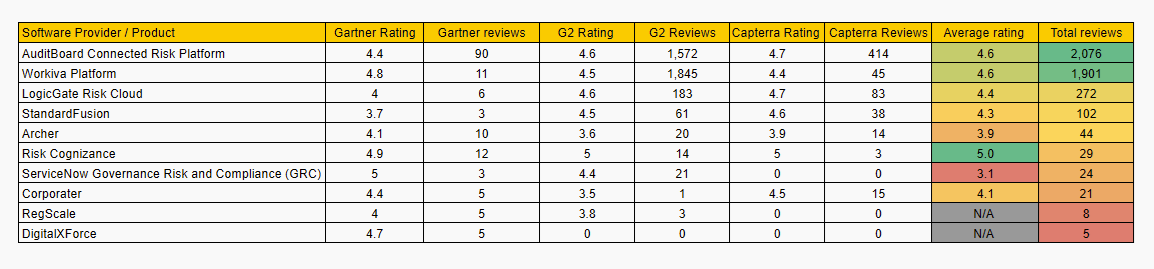
Here we have compiled a list of some of the leading Governance, Risk and Compliance (GRC) software providers on the market today. We have examined reviews on the web to create a first-stop list that you can use to inform your decision-making once you have entered the market.
1. AuditBoard Connected Risk Platform
AuditBoard’s Connected Risk Platform is built to unify audit, risk, and compliance work in one environment, helping teams standardise processes and keep evidence connected to the right controls and risks. It is commonly positioned around improving visibility across the risk landscape, reducing manual effort in audit and compliance workflows, and supporting consistent execution across programmes. The platform typically appeals to teams that want a structured way to manage risk assessments, controls, issues, and reporting, while keeping stakeholders aligned through clear workflows and ownership.
Key strengths:
- Strong workflow structure for risk, controls, and issues
- Built for audit readiness and evidence management
- Reporting designed for cross-team visibility and governance
- Scales well across multiple programmes and frameworks
Often chosen by: internal audit, risk, and compliance teams that want connected workflows and clearer oversight across enterprise risk and assurance activity.
Reviews snapshot: Average rating 4.6 (2,076 total reviews)
2. Workiva Platform
Workiva is widely used for connected reporting and governance work, supporting structured collaboration across stakeholders and helping organisations keep data, narratives, and controls aligned. In a GRC context, it is often used to reduce version control issues, centralise documentation, and support audit-friendly reporting workflows. The platform’s broader positioning focuses on transparency, collaboration, and traceability, which can be valuable when multiple teams contribute to risk, compliance, and assurance outputs on tight timelines.
Key strengths:
- Strong collaboration and workflow governance
- Structured reporting and documentation control
- Traceability and transparency across contributors
- Useful for programmes where reporting and assurance overlap
Often chosen by: organisations with complex reporting and governance needs, especially where multiple teams must collaborate on compliance, risk, and audit outputs.
Reviews snapshot: Average rating 4.6 (1,901 total reviews)
3. Risk Cognizance
Risk Cognizance positions its platform around bringing key GRC activities into one system, typically including risk management, compliance tracking, control oversight, and structured workflows for remediation. It is often framed as a practical option for standardising GRC operations without relying on disconnected spreadsheets, manual chasing, or inconsistent documentation. The overall value tends to be in helping teams organise risk and compliance activity into repeatable processes, with clearer ownership and reporting.
Key strengths:
- Consolidates risk and compliance activity into one workflow
- Emphasis on structured processes and accountability
- Designed to reduce manual admin and improve consistency
- Useful for teams building out formal GRC programmes
Often chosen by: organisations that want a straightforward platform to formalise GRC workflows and improve control and compliance visibility.
Reviews snapshot: Average rating 5.0 (29 total reviews)
4. LogicGate Risk Cloud
LogicGate Risk Cloud is typically positioned as a configurable GRC platform built around workflow automation and adaptability. It is known for supporting a range of GRC use cases, from risk assessments and vendor risk to compliance workflows and incident or issue management. The platform’s appeal is often the ability to tailor processes without heavy development, helping teams build repeatable workflows that match how their organisation manages risk in practice.
Key strengths:
- Highly configurable workflows for different risk use cases
- Automation designed to reduce manual handoffs
- Supports multiple programmes within one platform
- Strong fit for teams that need flexibility as they scale
Often chosen by: risk and compliance teams that want a configurable system to manage multiple GRC workflows without rebuilding processes in separate tools.
Reviews snapshot: Average rating 4.4 (272 total reviews)
5. StandardFusion
StandardFusion is positioned as a unified GRC platform that helps organisations manage compliance requirements, risks, controls, and policies in one place. It commonly supports teams that need to keep frameworks organised, track progress against obligations, and maintain audit-ready evidence. The platform is often associated with making compliance work more structured, reducing the burden of manual tracking, and improving day-to-day visibility into what is on track, what is overdue, and where remediation is needed.
Key strengths:
- Centralised compliance, risk, and control management
- Policy and evidence organisation for audit readiness
- Good visibility into tasks, ownership, and progress
- Strong fit for organisations managing multiple frameworks
Often chosen by: compliance and security teams that need to manage frameworks, evidence, and remediation in a single system.
Reviews snapshot: Average rating 4.3 (102 total reviews)
6. Corporater
Corporater positions itself as an enterprise management platform that supports governance and performance oversight, often spanning strategy execution, risk, compliance, and reporting. In GRC programmes, it is generally used where organisations want a structured way to connect governance processes with planning, oversight, and executive reporting. The platform tends to suit teams looking for broad governance tooling and structured management views, rather than a narrow, single-purpose GRC workflow.
Key strengths:
- Enterprise governance and management orientation
- Reporting and oversight focus for leadership visibility
- Suitable for broader governance programmes beyond compliance
- Works well where governance and performance intersect
Often chosen by: larger organisations that want GRC aligned with enterprise governance and performance management, with strong executive reporting.
Reviews snapshot: Average rating 4.1 (21 total reviews)
7. Archer
Archer is a long-established name in the GRC space, often used for enterprise risk management, compliance tracking, and control oversight across large organisations. It is typically positioned for structured governance at scale, where teams need consistent processes, defined ownership, and reporting that supports oversight and audit readiness. Archer is often associated with environments that require strong structure and breadth across use cases, particularly for mature or complex risk programmes.
Key strengths:
- Well suited to enterprise-scale risk and compliance programmes
- Supports structured governance and ownership models
- Useful for organisations with multiple risk domains and frameworks
- Strong fit where standardisation is a priority
Often chosen by: large organisations with mature GRC programmes that need enterprise governance controls and structured oversight.
Reviews snapshot: Average rating 3.9 (44 total reviews)
8. ServiceNow Governance, Risk and Compliance
ServiceNow’s GRC capability is typically positioned around workflow automation, integration, and connecting risk and compliance activity to day-to-day operational processes. It often appeals to organisations already using ServiceNow for IT and enterprise workflows, where keeping GRC activity connected to ticketing, service management, and operational ownership can reduce delays and improve traceability. The value tends to be strongest when GRC must integrate tightly with enterprise systems and processes.
Key strengths:
- Strong workflow automation and enterprise integration potential
- Useful for connecting GRC actions to operational teams
- Works well in organisations already standardised on ServiceNow
- Supports structured tracking and traceability of remediation
Often chosen by: enterprises that want GRC embedded into wider operational workflows and already run key processes through ServiceNow.
Reviews snapshot: Average rating 3.1 (24 total reviews)
9. RegScale
RegScale is positioned around continuous compliance and control management, helping teams maintain visibility into obligations, controls, and evidence as requirements evolve. It typically supports structured tracking across frameworks and aims to reduce the friction of maintaining compliance posture over time. This type of platform tends to suit organisations that want a more continuous, operational approach to compliance management, with clear mapping and documentation controls.
Key strengths:
- Continuous compliance orientation
- Control and evidence management focus
- Supports framework tracking and obligation mapping
- Useful for teams prioritising ongoing compliance visibility
Often chosen by: organisations that want to operationalise compliance and keep control and evidence management up to date across frameworks.
Reviews snapshot: Average rating 2.6 (8 total reviews)
10. DigitalXForce
DigitalXForce is positioned as a GRC option focused on supporting governance and compliance workflows, with an emphasis on simplifying oversight and improving consistency in how work is tracked. It is typically relevant for teams that want a structured environment to manage GRC activity and reporting, particularly where manual tracking creates gaps in accountability or audit readiness. With limited review coverage, it is best evaluated directly against programme requirements and workflow needs.
Key strengths:
- Structured approach to governance and compliance workflows
- Aims to improve consistency and oversight
- Useful where manual tracking creates audit gaps
- Can support formalisation of GRC processes
Often chosen by: organisations looking to formalise governance and compliance tracking in a dedicated platform.
Reviews snapshot: Average rating 1.6 (5 total reviews)
What to look for in GRC software
The above providers are a great place to start, but make sure you are looking at the right criteria when you start your search for new GRC software. Below you will find some of the key things to look out for.
Scope and methods
- Coverage for key risk domains: operational, IT/cyber, compliance, third party, H&S, and strategic risk in one system.
- Consistent methods: standard risk matrices, impact/likelihood scales, control ratings, and support for frameworks like ISO, COSO, NIST, and internal policies.
Workflows and actions
- End-to-end lifecycle: capture risks/issues, assess, plan treatment, approve, and close with full audit trail.
- Action tracking: clear owners, due dates, reminders, and escalation for risk treatments, control fixes, and audit actions.
Guidance and usability
- Embedded guidance: templates, control libraries, model risk registers, and example tests to help non-specialists.
- Adoption-friendly UX: simple interfaces, contextual help, and nudges so users keep information current.
Reporting and insight
- Layered dashboards: executive heatmaps plus drill-downs for business units, processes, and locations.
- Trend analysis: hotspots by owner, location, or process, with views of emerging risks and assurance coverage.
Security and integrations
- Strong security: role-based access, segregation of duties, granular permissions, and audit logging.
- Enterprise fit: secure hosting, SSO, APIs, and integration with EHS, ERP, ITSM, and security tools, with appropriate data residency and privacy controls.