Traditional frameworks within environmental health and safety (EHS) have historically prioritised physical safeguards, asset integrity, and strict procedural compliance. However, modern workforce data indicates that the next frontier of risk mitigation lies within the psychological climate of the operational environment.
In high-risk sectors such as manufacturing, oil and gas, and construction, the barrier between a routine operation and an incident often depends largely on an individual’s willingness to speak up.
Previously, we’ve discussed what psychological safety at work is and how to conduct a psychological risk assessment, with a brilliant piece by Nicky Cheetham-Whitfield detailing senior leadership’s personal duties under Section 37.
In this article, we’ll dive a bit further into psychological safety at work by exploring Dr Timothy Clark’s Four Stages of Psychological Safety, and discuss how safety directors can use it on high-risk sites to enhance risk reporting, eliminate operational blind spots and help fulfil modern regulatory duties.
What’s the relationship between physical safety and psychological climate?
There is an absolute relationship between physical safety on site and the psychological climate. When an environment lacks psychological safety, the physical wellbeing of the workforce is directly endangered.
The concept of psychological safety refers to a shared belief that a team environment is safe for interpersonal risk-taking. In practice, this means employees feel comfortable reporting hazards, admitting errors, or questioning instructions without fear of negative repercussions or individual blame.
Data from the Dräger Safety and Health at Work 2025 research report (DSHAW) reveals a stark disconnect in modern industries. While 96% of workers surveyed stated they felt physically safe at work, a substantial 65% believed a lack of psychological safety actively contributed to heightened safety risks within their workplace.
The report identified the top contributing risks were:
- High workload and severe time pressures (48%)
- Extraneous life stressors, such as personal financial concerns (42%)
- A distinct lack of supportive leadership (30%)
When these pressures accumulate, frontline workers often bypass safety controls to maintain production velocities, concealing minor errors that eventually compound into severe incidents.
And with the DSHAW report revealing 80% of responders agreeing mental health and wellbeing are linked to workplace safety and must be managed together, it’s imperative leadership start including psychological safety frameworks in their conversations. Better collaborations between HR and health and safety teams will ultimately help foster a more welcoming, safe and open environment for all employees.
An introduction to the four stages of psychological safety framework by Dr Timothy Clark
Clark structured the concept of psychological safety into a progressive behavioural model. He defines psychological safety as a culture of ‘rewarded vulnerability’. Within this framework, teams advance through four distinct stages, each satisfying a fundamental human need. As a team moves up the spectrum, the level of permitted vulnerability increases, which unlocks higher levels of engagement and critical thinking.
| Name | Core human need | Operational manifestation | |
| Stage 1 | Inclusion safety | To belong and be accepted | Workers feel valued as individuals, regardless of seniority. |
| Stage 2 | Learner safety | To learn and grow | Team members freely ask questions, experiment and admit mistakes. |
| Stage 3 | Contributor safety | To make a meaningful difference | Autonomous execution of tasks within safe and defined boundaries. |
| Stage 4 | Challenger safety | To question the status quo | The freedom to halt production or challenge unsafe directives. |
By understanding this progression, EHS leaders can identify exactly where their operational culture succeeds and where penalised vulnerability is driving critical data underground.
Stage 1: Establishing inclusion safety for diverse frontline teams
Inclusion safety forms the foundation of Clark’s stages of psychological safety framework. It addresses the basic human need to be accepted into a social structure without fear of exclusion or discrimination. In high-risk industrial environments, teams are frequently transient, consisting of a mixture of full-time employees, subcontractors and specialised engineers.
When inclusion safety is absent, a dangerous “us versus them” dynamic can develop between different tiers of personnel or between frontline staff and management. Subcontractors who feel excluded are statistically less likely to engage with internal safety reporting mechanisms or attend voluntary safety briefings.
Building inclusion safety requires visible leadership engagement and practical, consistent actions. Site managers must ensure that all personnel are integrated into the daily routine.
Some simple practices that can help establish a sense of shared community are:
- Making sure every subcontractors name is known
- Celebrating diverse operational experiences
- Conducting comprehensive and respectful inductions
McKinsey research suggests 89% of employees believe a psychologically safe climate directly encourages a stronger community and better innovation. When inclusion safety is solid, workers transition from viewing themselves as isolated units to seeing themselves as valued parts of a collective safety network.
Stage 2: Cultivating learner safety to combat the cost of concealed errors
Once workers feel they genuinely belong on site, they require the psychological security to learn. Learner safety allows individuals to ask questions, seek feedback, try new techniques, and, crucially, make mistakes without fear of ridicule or reprimand.
In a high-risk setting, the transition to a new piece of machinery or an updated standard operating procedure introduces immediate cognitive demands. If learner safety is low, an operator who is uncertain about a complex valve sequencing procedure or the calibration of a gas detector may choose to guess rather than ask for clarification. They do this to avoid looking incompetent in front of peers or supervisors.
Cultivating learner safety requires a complete shift in how management responds to errors. Leaders must actively position work as a learning challenge rather than a pure execution task.
Supervisors can model this behaviour by openly discussing their own operational mistakes or knowledge gaps during regular safety meetings. This helps everybody to continually think about risks, encourages them to point out risks early on, and creates a comfortable environment for genuine feedback, honesty and discussion.
When minor errors or deviations are treated as vital learning data points rather than disciplinary offences, your organisation eliminates the practice of concealed errors, allowing for early intervention before those errors manifest as physical incidents.
Stage 3: Transitioning to contributor safety on the production floor
Stage 3 in Clark’s framework is contributor safety, which satisfies the human need to use one’s talents and skills to make a meaningful difference. In traditional safety, frontline workers are often treated as passive followers of strict rules. While procedural compliance is necessary, it can lead to a state of apathy if overemphasised at the expense of human engagement.
When contributor safety is established on the production floor, workers go from merely completing tasks to actively solving problems. They’re granted the autonomy to execute work within safe and clearly defined boundaries.
For example, an experienced maintenance technician should feel empowered to optimise a preventative maintenance sequence based on real-time observations of machine wear, provided the modifications remain within engineering tolerances.
Leaders can foster contributor safety by:
- Delegating authority and roles clearly
- Setting clear high-level outcomes
- Allowing teams the operational space to execute the work their way
- Publicly expressing gratitude and recognising individual contributions
This helps reinforce to the wider team that proactive engagement is both safe and valued by executive management.
Cultivating contributor safety directly aligns with HOP frameworks
The Human & Organisational Performance (HOP) positions workers as a primary resource for problem solving. This approach relies on worker involvement and open communication about operational realities.
When evaluating risks, contributor safety makes sure the ‘work as imagined’ by engineers in corporate offices matches the ‘work as done’ by operators on the shop floor. By using tools, such as learning teams where frontline workers and safety facilitators work together to map out how tasks are actually accomplished, organisations are able to identify hidden systemic hazards.
Research by Accenture shows organisations that actively cultivate this level of safety at work can experience a 76% increase in employee engagement and a 50% rise in general productivity.
Stage 4: Why challenger safety is critical to preventing serious workplace incidents
The final and most critical stage of the framework is challenger safety. Challenger safety grants team members the freedom to vocalise concerns, question decisions by upper management, and expose systemic risks without fear of retaliation, career damage or professional isolation.
In high-risk environments, one of the most severe liabilities an organisation can possess is an executive climate that only tolerates positive updates. This dynamic creates a large operational blind spot.
Senior directors look at dashboards showing perfect safety statistics but remain completely unaware that frontline teams are routinely bypassing engineering controls or working under intense pressure just to maintain production velocity.
Dismantling this blind spot requires a culture where near-miss reporting increases substantially. A rise in near-miss reports is an indicator of robust challenger safety. It proves that workers trust the system enough to expose hidden vulnerabilities before they escalate into major disasters.
Real world examples of low challenger safety
Investigations into major catastrophic events routinely reveal that technical flaws were known by frontline personnel long before the failure occurred, but a toxic organisational culture prevented them from speaking up effectively.
The Space Shuttle Challenger Disaster (1986)
Engineering specialists were fully aware that the O-ring seals could fail under cold launch conditions. Intense political and schedule pressures created an environment where challenging the launch decision was actively discouraged, leading to a tragic loss of life.
The Deepwater Horizon Blowout (2010)
Multiple indicators of abnormal well pressure were observed by offshore personnel prior to the explosion. A complex, multi-contractor hierarchy and a focus on minimising operational delays meant that individuals hesitated to firmly challenge assumptions or completely halt operations, resulting in an environmental and human disaster.
In both cases, the formal safety management systems were extensive, but the psychological climate penalised the vulnerability required to challenge institutional momentum.
Limitations of the four stages model
Challenges in rapidly shifting high-risk environments
While Dr Timothy Clark’s psychological safety framework offers a fantastic pathway, it’s important to recognise its practical limitations when applied to fast moving industrial environments. High-risk sites are dynamic. Weather conditions change rapidly, equipment fails unexpectedly and changes to team members happen regularly.
The four stages of psychological safety framework presents a linear, progressive spectrum. In reality, psychological safety is fragile and non-linear. A team may operate at Stage 4 during a morning toolbox talk then instantly regress if a supervisor acts negatively to an unexpected delay on the plant floor.
This doesn’t discredit the framework entirely. What it means is that the model requires continuous, active maintenance and should be one of many frameworks leadership uses as a guide to creating and maintaining a psychologically safe culture at work.
The risk of removing accountability
A common misunderstanding among management teams is the assumption that increasing psychological safety means lowering performance standards or reducing operational accountability.
Enforcing psychological comfort without maintaining rigorous operational discipline risks pushing the business into what cultural researchers call the comfort zone. In this state, teams feel safe and familiar, but there is no drive for excellence, and adherence to critical safety barriers can degrade.
Conversely, enforcing high accountability without psychological safety pushes teams into the anxiety zone, which is characterised by intense stress, fear of judgment, and suppressed reporting.
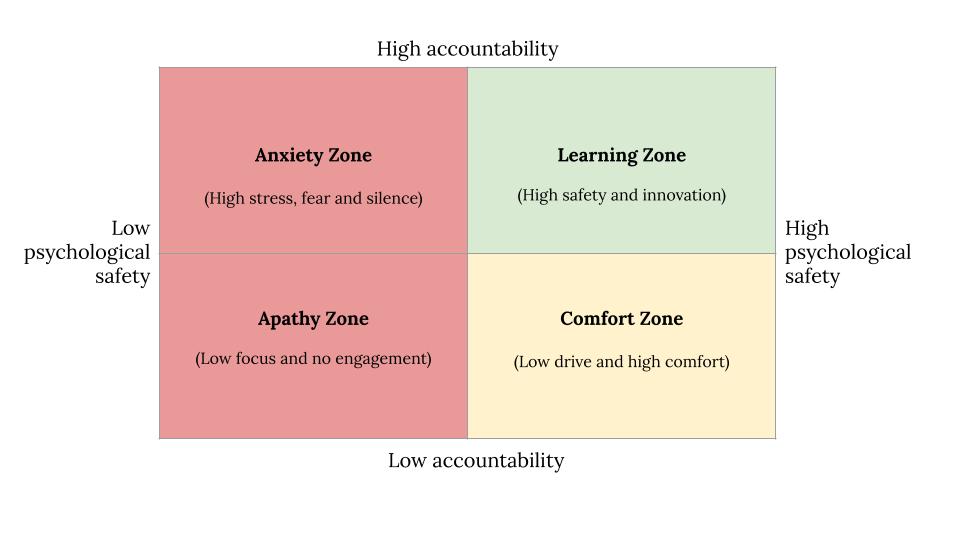
The objective for EHS directors is to position their teams firmly within the learning zone. This is where high psychological safety and high operational accountability coexist. Workers are fully supported and feel safe to speak up, but they remain deeply accountable for maintaining standard operating procedures and respecting critical engineering controls.
Actionable strategies to overcome cultural barriers and move your team up the spectrum
To successfully shift operational teams up the spectrum from basic inclusion to active challenger safety, senior safety leaders must implement deliberate, structural interventions.
Redesign the feedback loop
Ensure that every near-miss report or hazard submission receives transparent, documented feedback. If a frontline worker takes the interpersonal risk to speak up and management fails to communicate what actions were taken, the worker perceives that their input is undervalued. This can cause them to regress down the psychological spectrum.
Conduct direct leadership coaching
Train line managers and site supervisors on how to receive bad news. Instead of asking “Who allowed this to happen?” supervisors must be coached to respond with open-ended questions: “What systemic factors contributed to this situation, and how can we support the team to resolve it safely?”.
Implement structured anonymity with open channels
Providing straightforward, accessible and anonymous reporting channels acts as a necessary bridge for teams currently stuck in low-safety environments, serving as a stepping stone toward open communication.
About the Author: Kim Le

With a foundation in medical and healthcare copywriting, Kim specialises in translating complex information into clear, compliant content within highly regulated sectors. At HSE Network, Kim collaborates closely with safety professionals, producing trusted, engaging material to champion safer working practices and foster stronger safety cultures.